How to pronounce quelquefois
Do you find the information below useful? If you do, you can get guides like it for 1,000+ French words by downloading this app for your iPhone or iPad.
| k | 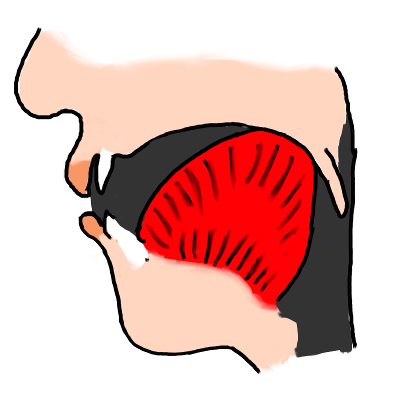 | A French 'k' sound (often written "qu" or, as in English, "c") is generally pronounced in a similar way to the English 'k' sound of "skin", "scan" etc. In other words, it is not usually followed by a "strong burst of air" (aspiration) as in the 'k' sound of English "kit", "can" etc. If you are a native English speaker, repeat the word "cool" then "school" while holding your hand in front of your mouth. In the word "cool", you'll feel a stronger burst of air than in "school". In French, you always pronounce the 'k' sound as in English "school", without the strong burst of air. | |
| ɛ | 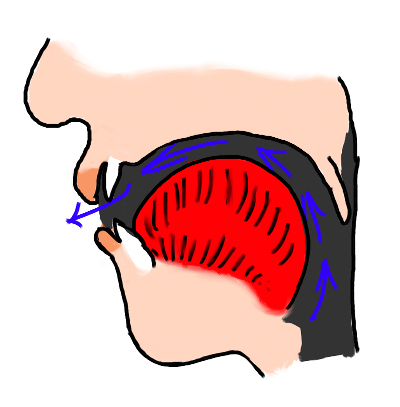 | The French 'open e' vowel, is pronounced with the tongue almost as far forward in the mouth as it will go, but with the mouth a bit more than half open. Keep your lips unrounded and aim to "hold your tongue and lips in position" (to avoid producing it as a "glide" or diphthong) as you pronounce this vowel. | |
| l | 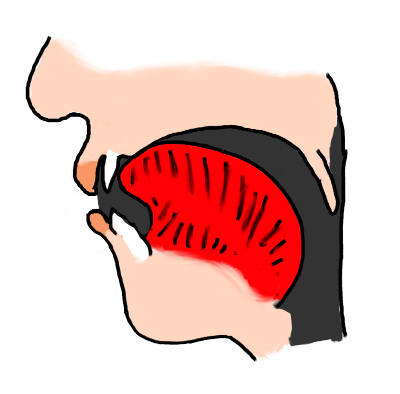 | The French 'l' is similar to the 'l' in English "with Lee". The tongue tip usually touches the back of the upper teeth. It is also a so-called "clear" l: in other words, you don't raise the back of your tongue as you pronounce the French 'l', as occurs in some cases in English. | |
| k | | A French 'k' sound (often written "qu" or, as in English, "c") is generally pronounced in a similar way to the English 'k' sound of "skin", "scan" etc. In other words, it is not usually followed by a "strong burst of air" (aspiration) as in the 'k' sound of English "kit", "can" etc. If you are a native English speaker, repeat the word "cool" then "school" while holding your hand in front of your mouth. In the word "cool", you'll feel a stronger burst of air than in "school". In French, you always pronounce the 'k' sound as in English "school", without the strong burst of air. | |
| ə | 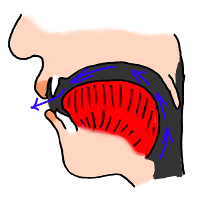 | The 'schwa' or 'neutral e' is pronounced with the tongue in a "central, relaxed" position and the mouth also in a 'half open, relaxed' position. Note that many French speakers actually tend to pronounce this vowel as a 'close eu' vowel (as occurs at the end of words ending in -euse), or at least with some rounding of the lips. | |
| f | 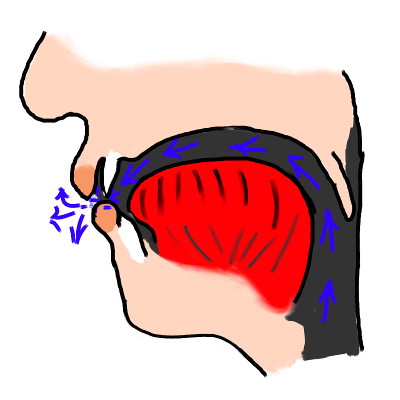 | The French 'f' sound is pronounced in a similar way to English 'f'. | |
| w | 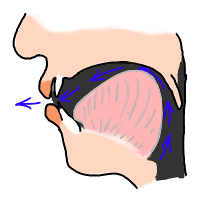 | This is a sound a little like an English "w", where you glide rapidly between a French 'ou' vowel and another vowel. When a French 'ou' vowel is followed by another vowel, the 'ou' usually automatically turns into this glide. | |
| a | 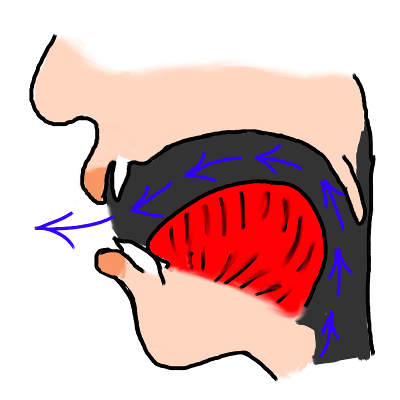 | The French 'a' vowel is pronounced with the tongue far forward in the mouth and the mouth quite wide open, but not quite as open as for a typical English 'a' vowel. |